Thursday, August 19, 2010

Thomas Ince

On a balmy Saturday in November, 1924, William Randolph Hearst's 280-ft. yacht, the Oneida, set sail for San Diego with some of Hollywood's most celebrated stars on board to honor the 43rd birthday of pioneer filmmaker Thomas Ince. As the Oneida eased out of San Pedro Harbor, skipper Hearst and hostess Marion Davies entertained their 15 guests with a band of jazz musicians and the best vintage champagne. Ince, however, was not on board. He was attending the premier of his latest film. The Mirage, but he managed to catch a train the following day to San Diego, where the Oneida had docked. What happened from the moment he boarded until his sudden death a few days later continues to be one of the most bizarre murder mysteries in the annals of Hollywood scandal.

In the aftermath of Ince's death, a series of strange events hinted at foul play on Hearst's yacht-perhaps involving Hearst himself. Hearst had the entire Oneida crew sworn to secrecy. Then he slipped away to New York, leaving Davis behind with a cryptic note saying that he thought it was best to go east since the situation in California was "so unsatisfactory." The Hollywood rumor mill was quick to notice his conspicuous absence at Ince's funeral. It wasn't the first time someone had died during a Hearst affair, and Hearst had an aversion to funerals. But why the oath of secrecy? Why did the guests refuse to talk?

Rumors began. Ince, it was hinted, had been shot by Hearst. Apparently Kono, Charlie Chaplin's secretary, who had been aboard the Oneida with Chaplin for the party, told the Japanese staff at Chaplin's home that he had seen a bullet hole in Ince's head as he was carried off the yacht. Very soon this story spread through the network of Japanese domestics in the Hollywood area, who in turn told their employers.

Speculation had it that it was Chaplin who was the actual intended victim of the alleged shooting. Hearst was unreasonably jealous of Chaplin's attention to Marion Davies, a seductive, flamboyant young woman, and he had invited Chaplin only to keep tabs on his behavior with her. This infuriated Miss Davies, who insisted that her feelings for Chaplin, a known ladies' man, were purely platonic. She and Charlie had been standing in the dimly lighted lower galley with Ince, the story said, when Hearst sighted them from above. Hearst flew into a jealous rage, ran for his diamond-studded revolver, and fired. Miss Davies screamed, in her notorious stammer, "M-m-m-murder!" as Ince slumped to the deck.

Both Ince and Chaplin had their backs to Hearst, and it has been deduced that Hearst was unable to distinguish between the two men, who looked somewhat alike. Marion Davies denies that there was ever a gun on board, but John Tebbel, Hearst's biographer, claims that Hearst was an expert marksman and that "it amused him to surprise guests on the Oneida by knocking down a sea gull with a quick hip shot."

The passage of more than 50 years hasn't brought to light the full story. Few of the friends and relatives questioned in subsequent biographies and newspaper reports agree as to cause of death. One notices in these accounts a manipulation of facts which gives the incident its disconcerting twists. It seems unlikely that so many people could remain silent for such a long time if a murder did in fact occur. Or were these Hollywood personalities simply covering up their own scandalous private lives, replete with extravagant parties, smuggled liquor, and sexual indiscretion?

One of the guests, Elinor Glyn, novelist, screenwriter and social entrepreneur, was outspoken about other Hollywood scandals in her biography but failed to mention this one. Charlie Chaplin also suffered a curious bout of amnesia in his memoirs and claims to have visited Ince on his sickbed two weeks before his death. Margaret Livingston, actress and alleged mistress of Ince, was there, although Marion Davies later denied it upon being asked by Mrs. Ince. Louella Parsons, Hearst reporter, claims that she wasn't even in California at the time, despite the fact that she was seen leaving the United Artists Studio with Chaplin and Davies. Other celebrities and Hearst employees were also on board, specifically Dr. Daniel Carson Goodman, who became a key witness in the shallow investigation that followed Ince's death.

Hearst himself added to the confusion with his own misleading story, published in the Hearst papers immediately after Ince died, with the headline: SPECIAL CAR RUSHES STRICKEN MAN HOME FROM RANCH! This erroneous account had Ince visiting Hearst at his ranch when he fell ill and made no mention of the Oneida party. The Hearst-Ince scandal also briefly made headlines in the Los Angeles Times: MOVIE PRODUCER SHOT ON HEARST YACHT. However, the Times report survived only one edition. Its editors killed it in later editions-an indication of Hearst's far-reaching power.

A thorough investigation and a detailed autopsy could have settled the controversy over Ince's death. But, curiously, Dr. Goodman was the only witness from the Oneida who was summoned when an investigation was finally called. After hearing the testimony of the attending physicians and Dr. Goodman, the San Diego district attorney dismissed the case and closed the investigation, saying that Ince had died from heart failure due to acute indigestion.

With all of the "evidence" reduced to hearsay, the death of Thomas Ince remains a mystery, tainted by overspeculation. Was it simply generosity, people wondered, that prompted Hearst to award Mrs. Ince a trust fund? Louella Parsons was granted a promotion by Hearst (supposedly to keep her quiet), and she went on to become a Hollywood gossip columnist. Chaplin shuttled his pregnant fiancee, Lita Grey, off to Mexico before Ince's funeral, then joined her a few days later to get married.

If it was temporarily forgotten that Ince was a great motion picture producer-director rather than a victim of scandal, Ince had his own subtle revenge. When Mrs. Ince sold their Spanish-style mansion, scene of many "frolicsome weekends" for the Hollywood elite, a secret gallery above the guest rooms was discovered. There Ince had fashioned a series of small peepholes in the floor above the guest rooms. These gave Ince an eyeful of each bedchamber, and while the stars dallied, he was probably admiring the view.

Hearst was known for his wild, impromptu parties, and a three-day voyage on the Hearst yacht was a coveted affair. But Hearst was a calculating man who had more in mind than just the indulgence of his favored friends. Hearst was trying to lure Ince, whose action films were losing popularity, into his movie empire, Cosmopolitan Productions, which Hearst had built for the sole purpose of promoting the career of Marion Davies, his 27-year-old mistress. The next move for Hearst would be to take over Ince Studios in Culver City, a proposition over which he and Ince were negotiating.

The yacht party may have been too intimate for words, for there are few accounts of the gala proceedings. Marion Davies recalled that it was fun and uneventful, up to a point. Mindful of prohibition laws, she reported, "We drank water and retired early."-raising suspicious Hollywood eyebrows on both claims. Ince drank amicably to all the toasts and vomited all night. He was taken from the boat in a stretcher the following morning stricken with what was called a severe attack of indigestion. Ince had an ulcer, aggravated by a nervous condition from overwork, and he was on a strict diet that did not include alcohol.

There are two conflicting versions of what happened to Ince after he was removed from the yacht. One version has someone summoning Ince's wife (who did not attend the party), along with his family doctor and two nurses. With this entourage, Ince was escorted to Los Angeles in a private railroad car and from there rushed by ambulance to his home in Benedict Canyon, where he died. The other version of the story has Ince dead before he left the yacht.

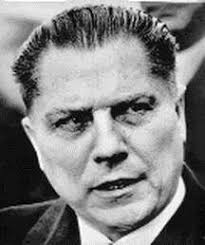
Jimmy Hoffa

One of the most famous American figures to inexplicably disappear was Jimmy Hoffa, the famed president of the Teamsters Union from 1957 until he went to prison in 1967. There was no question that Hoffa had a lot of enemies in his day and perhaps none so powerful as Robert F. Kennedy, the president’s brother and the attorney general from 1961 to 1964. Hoffa’s ties to organized crime landed him in prison but it would not be until those same gangsters turned against him would those ties lead to his disappearance and likely murder. And while Hoffa’s body has never been found, there is little question about whether or not he is dead. One way or another, Hoffa is not coming back...

For many years, Hoffa was the controversial leader of the Teamsters Union, which boasted strong connections to organized crime. Despite his underworld dealings though, Hoffa was immune to prosecution through the 1950’s. In the early 1960’s, he became the chief target of Bobby Kennedy, chief counsel to the Senate Select Committee on Improper Activities in the Labor or Management Field (popularly called the McClellan Committee), and later, the attorney general. In 1961, Kennedy made Hoffa the top priority of his administration and his efforts resulted in the labor leader’s 1962 trial for extorting illegal payments from a firm that employed Teamsters. The proceedings ended in a hung jury but then Hoffa was arrested for attempting to bribe one of the jurors. He was sentenced to eight years in prison.

In 1964, Hoffa was convicted of misappropriating $1.7 million in union pension funds but managed to stay out of prison until 1967. He ended up serving 58 months and has his sentence commuted by President Nixon with the condition that he stayed out of union politics until 1980, which would have been the full term of his prison sentence. Hoffa didn’t take this condition seriously and he started legal action to get it set aside. In addition, he went ahead with efforts to regain control of the union from his former “right-hand man”, Frank Fitzsimmons. This maneuver did not sit well with mob leaders, as Fitzsimmons was much easier to manipulate than the stubborn Hoffa and could always be counted on to look the other way. He was also welcome at the White House, which Hoffa was not, and was infinitely more desirable as the head of the union. Hoffa was warned several times by mobsters to stop interfering and trying to regain his position but, not surprisingly, he refused to listen.

On July 30, 1975, Hoffa went to the Red Fox Restaurant outside of Detroit to allegedly meet three men, a Detroit labor leader, an important local mobster and a powerful figure in New Jersey Teamster politics. Hoffa arrived first, around 2:00 in the afternoon, but after waiting nearly 30 minutes, none of the others had arrived. Annoyed, he called his wife and told her that he was going to wait for a few more minutes before giving up. This was the last time that she ever spoke with her husband.

At 2:45, Hoffa was seen getting into a car in the restaurant parking lot with several other men. Investigators are pretty sure that he never got out of the car alive. According to FBI investigators, Hoffa had been brought to a peace conference with mobster Anthony “Tony Pro” Provenzano and then had been killed. Provenzano was just one of the long list of suspects in Hoffa’s disappearance, although he had a good alibi at the time of the union leader vanished. In fact, some would say that it was too good. Tony was apparently touring a number of union officials around Hoboken, New Jersey on July 30. He made not have actually “done the deed” but that did not mean that he wasn’t involved.

Provenzano was far from alone on the suspect list. The number of possible killers grew as investigators probed their underworld connections and spoke with convicts who were looking for reductions in their sentences. The main suspects were Provenzano, Russell Bufaliano and two Hoffa cronies, Thomas Andretta and Gabriel Briguglio. Another suspect, Briguglio’s brother, Salvatore, was believed to be informing to the FBI when he was shot to death in March 1978.

As the investigation continued on, loose ends began to unravel everywhere. One of the most obvious mysteries was why Provenzano would have linked himself to a meeting with Hoffa if he planned to kill him? This seemed almost as odd as why the men who were supposed to kill Hoffa showed up 45 minutes late! This was not the usual for mob hitmen, who find punctuality certainly makes the job easier. These questions notwithstanding, the authorities were able to track down the auto that Hoffa got into and they did find traces of blood and hair inside. They were convinced that Hoffa got into the car and then was garroted from behind.

But was he really killed? Some insisted that he was not. One union official, after long bouts of questioning by the FBI, swore that Hoffa had skipped off to Brazil with a “black go-go dancer”. Supposedly, this was the inside story among union members!

In all reality though, it is unlikely to be the truth. In the years since 1975, Hoffa has been declared legally dead and most of the suspects in the case are dead themselves or have gone to prison on other charges. Any convictions for the murder of the vanished union leader would depend on testimony from an inside source - and don’t look for that anytime soon! As one unidentified union official stated: “We all know who did it. It was Tony and those guys of his from New Jersey. It’s common knowledge. But the cops need a corroborating witness, and it doesn’t look like they’re about to get one, does it?”

There have been many stories and theories about what happened to Hoffa that day. Here are a few of them:

- According to Ralph Picardo, the convict who gave up the main suspects in the case, Hoffa’s body was put in a 55-gallon steel drum and carted away in a  truck. Picardo said he didn’t know where it was taken but one theory had it that the drum was buried on the grounds of Brother Moscato’s garbage dump, a toxic waste site in Jersey City, New Jersey.

- According to another snitch, Hoffa’s body was taken to New Jersey where it was mixed into the concrete that was used to construct the New York Giant’s football stadium in East Rutherford, New Jersey. He was also said to have been  encased in the foundation of a public works garage in Cadillac, Michigan and buried under the helipad at the Sheraton Savannah Resort Hotel, which at the time of his disappearance was owned by the Teamsters.

- Hoffa was said to have been buried in a gravel pit in Highland, Michigan, which was owned by his brother William; crushed in an automobile compactor at Central Sanitation Services in Hamtramck, Michigan or buried in a field in  Waterford Township, Michigan.

- He was also alleged to have been ground up at a meat processing plant and then dumped in a Florida swamp or disintegrated at a fat-rendering plant.

Hoffa was declared legally dead in 1982, but his case remains open. A special agent at the FBI’s Detroit field office is still assigned to it. The investigation has generated over 16,000 pages of documents gathered from interviews, wiretaps, and surveillance, but despite the government’s best efforts to get to the bottom of Jimmy Hoffa’s disappearance, what really happens to him remains a mystery.

And so, officially, Jimmy Hoffa walked away from a Detroit restaurant one day and vanished into the ether. He was never seen or heard from again. Whether or not his body is hidden away in a landfill or beneath the concrete of a football stadium is anyone’s guess, but one things is for sure --  we’ll certainly never see him again.

Marilyn Monroe

It remains one of Hollywood's most compelling, and unforgettable, mysteries.

On August 5, 1962, the body of Marilyn Monroe was found in the bedroom of her Brentwood home. The 36-year-old movie star was naked and face down on her bed.

An autopsy conducted by Dr. Thomas Noguchi, then deputy medical examiner, concluded that death was due to acute barbiturate poisoning, and a psychiatric team tied to the investigation termed it a "probable suicide."

Today, 43 years later, fans from around the world will gather, as they have for decades, near Monroe's crypt at Westwood Village Memorial Park to celebrate her life and mourn her death. John W. Miner, 86, will mourn too.

But there is bitterness and frustration as well for the former Los Angeles County prosecutor, who was at her autopsy and was one of those looking into her death. He didn't believe that the actress took her life in '62 and he doesn't believe it now, and Miner says he's heard secret tapes that Monroe made in the days before she died that prove the actress was anything but suicidal.

Whether Monroe died by her own hand has been debated and dissected by books, documentaries, conspiracy theorists, and Hollywood and Washington insiders alike for years.

Enough credence was given to the various reports that in 1982, the Los Angeles County district attorney's office reexamined the case. Miner, by then in private practice, was among those interviewed.

The resulting report notes that Miner mentioned the tapes. However, he did not say he had a transcript. Although the report concedes that "factual discrepancies" and "unanswered questions" remained in the case, it did not find enough evidence to warrant launching a criminal investigation.

As head of the D.A.'s medical-legal section when Monroe died, Miner had met with the actress' psychiatrist, Dr. Ralph Greenson. During the interview, Miner says, Greenson played the Monroe tapes, but only on condition that the investigator never reveal their contents.

Miner said he took "extensive" and "nearly verbatim" notes, and only broke the promise years after Greenson's death, when some Monroe biographers suggested that the psychiatrist be considered a suspect in her death. Miner recently gave a copy of the transcript to The Times.

Miner's transcript shows Monroe obsessing about the Oscars, describing a sexual encounter with Joan Crawford, craving a father's love from Clark Gable, yearning to be taken seriously as an actress by contemplating doing Shakespeare, and speaking candidly about why her marriages to baseball slugger Joe DiMaggio and playwright Arthur Miller ended in divorce.

At one point, she describes standing naked in front of her full-length mirror assessing the body that captivated the world, knowing that she is slipping into middle age, and commenting that "my breasts are beginning to sag a bit" but "my waist isn't bad" and her buttocks are still "the best."

"You are the only person who will ever know the most private, the most secret thoughts of Marilyn Monroe," she tells Greenson, according to Miner's transcript. "I have absolute confidence and trust you will never reveal to a living soul what I say to you."

Miner contends that anyone reading the transcript would conclude that "there was no possible way this woman could have killed herself. She had very specific plans for her future. She knew exactly what she wanted to do. She was told by [acting coach] Lee Strasberg, maybe ill-advisedly, that she had Shakespeare in her and she was fascinated with the idea."

Miner has shown the transcript to several authors in recent years. In British author Matthew Smith's book "Marilyn's Last Words: Her Secret Tapes and Mysterious Death," the excerpts cover the early portion of the tapes, which have Monroe musing on Freud and free association, orgasms, Gable and her agent, Johnny Hyde. Seymour M. Hersh included a short reference to the late President Kennedy in "The Dark Side of Camelot."

Miner was also interviewed for a 1997 ABC documentary called "Dangerous World: The Kennedy Years," but ultimately no excerpts from the transcript were used.

The previously unpublished portions of the transcript include descriptions of her feelings for her ex-husbands, a dissection of why her marriages failed, a racy catalog of supposed sexual encounters, details of her dispute with 20th Century Fox, her friendship with Frank Sinatra, and her complaints about housekeeper Eunice Murray, who would discover her body.

Smith and Hersh, along with the documentary's producer, Mark Obenhaus, said in interviews this week that they found Miner credible.

But to accept Miner's story, one must make a leap of faith - he is the only one still alive who claims to have heard the tapes. Greenson died in 1979, and Miner believes that he destroyed the tapes.

"It's like a one-sourced story," Obenhaus said. "You have one guy; he's a credible guy, but he's just one guy."

Smith, who said he paid Miner a fee, which he declined to disclose, for use of the Monroe transcript, added: "I believe he is a man of integrity. I've looked at the contents of the tapes, of course, and, frankly, I would think it entirely impossible for John Miner to have invented what he put forward - absolutely impossible."

Ronald H. "Mike" Carroll, a former L.A. County deputy district attorney who conducted the 1982 review of Monroe's death, said he and a D.A.'s investigator interviewed Miner for their report and, although he mentioned that Greenson had tapes of the actress, there was no hint that Miner had a transcript.

Carroll, the No. 3 prosecutor in the D.A.'s office at the time, who has since retired, said that had he any inkling that Miner was harboring the transcript, he would have obtained a grand jury subpoena to force Miner to hand them over so that he could include them in his report.

Miner said he couldn't speak about the transcript then because of his promise to Greenson. "Greenson … was absolutely committed to protecting the privacy of his patients," Miner recalled. "He felt he could not let me see what she had said if there was any possibility that her privacy would be violated." So Miner gave his word.

When some suggested that Greenson himself was the actress' killer, Miner went to the psychiatrist's widow and asked for permission to be released from the promise.

Greenson's widow, Hildegard, told The Times this week that she didn't know if the tapes existed and never heard her husband discuss them. Still, she does not discount that Monroe may have given her husband such tapes and that he played them for Miner.

"That seems like something my husband would do," she said. "He might want to play it to show how she felt and what was going on with her." At the time of the recordings, Monroe was living an unsettled life. There was the rumor of a romance with Kennedy, fueled by her appearance at a birthday tribute on May 19 at Madison Square Garden where she sang the now legendary "Happy Birthday, Mr. President." Studio bosses at 20th Century Fox had dropped her from the film "Something's Got to Give" because of chronic lateness and drug dependency.

No one has established the exact date that the recordings were made, although the JFK reference would put it after her singing tribute, a little more than two months before she died.

Smith says his research suggests that Monroe gave the psychiatrist the tapes Aug. 4. According to Miner, Greenson's sole purpose in playing the tapes for him was to help establish her state of mind at the time of her death, "so they were made pretty close to the time she died."

Hollywood columnist James Bacon, now 91, who met Monroe when she was an unknown in 1949 and would later become a close friend, was at Monroe's house five days before she died.

"She was drinking champagne and straight vodka and occasionally popping a pill," Bacon told The Times. "I said, 'Marilyn, the combination of pills and alcohol will kill you.' And she said, 'It hasn't killed me yet.' Then she took another drink and popped another pill. I know at night she took barbiturates."

But Bacon added: "She wasn't the least bit depressed. She was talking about going to Mexico. She had a Mexican boyfriend at the time. I forget his name. This was the first house she ever owned. She was going to buy some furniture. She was in very good spirits that day - of course, the champagne and vodka helped."

In the transcript, Monroe uses what therapists call "free association," saying whatever came into her mind. "Isn't it true that the key to analysis is free association?" she says. "Marilyn Monroe associates. You, my doctor, by understanding and interpretation of what goes on in my mind, get to my unconscious, which makes it possible for you to treat my neuroses and for me to overcome them."

"And you are going to hear bad language," she warns Greenson.

Although Monroe often came across on screen as a ditzy blond, in her tapes, she discusses Freud's "Introductory Lectures" ("God, what a genius," she remarks. "He makes it so understandable"), and author James Joyce ("Joyce is an artist who could penetrate the souls of people, male or female"), and says she has read all of Shakespeare.

She talks about her admiration for Gable, her co-star in "The Misfits": "In the kissing scenes, I kissed him with real affection. I didn't want to go to bed with him, but I wanted him to know how much I liked and appreciated him."

And she lambasted members of the Academy of Motion Picture Arts and Sciences for not giving Gable an Oscar for "Gone With the Wind," noting that never was an actor on screen more romantic. She says she cried for two days after learning that Gable had died.

Her love for DiMaggio was undimmed. "I love him and always will," she says. "But Joe couldn't stay married to Marilyn Monroe, the famous movie star. Joe has an image in his stubborn Italian head of a traditional Italian wife. She would have to be faithful, do what he tells her, devote all of herself to him. Doctor, you know that's not me."

It was different with Miller. "Marrying him was my mistake, not his. He couldn't give me the attention, warmth and affection I need. It's not in his nature. Arthur never credited me with much intelligence. He couldn't share his intellectual life with me. As bed partners, we were so-so."

Of her one-night affair with Joan Crawford, she said: "Next time I saw Crawford, she wanted another round. I told her straight-out I didn't much enjoy doing it with a woman. After I turned her down, she became spiteful."

In the tapes, Monroe heaps praise on Kennedy, and there is no suggestion that the two were ever lovers. "This man is going to change our country," she says of JFK, adding, "He will transform America today like FDR did in the '30s."

As for the president's brother, Robert F. Kennedy, the U.S. attorney general at the time: "As you see, there is no room in my life for him. I guess I don't have the courage to face up to it and hurt him. I want someone else to tell him it's over. I tried to get the president to do it, but I couldn't reach him."

In the transcripts, Monroe says she needs Greenson's help in getting her housekeeper another job. "Doctor, I want you to help me get rid of Murray…. I can't flat out fire her. Next thing would be a book 'Secrets of Marilyn Monroe by Her Housekeeper.' She'd make a fortune spilling what she knows and she knows too damn much."

As he listened to Monroe's voice that day in 1962, Miner said, he became "very moved."

"You'd have to be without capacity for empathy or emotion" if you weren't moved, he said.

Miner, who collaborated with Dr. Seymour Pollack to create the USC Institute of Psychiatry, Law and Behavioral Science in 1963 and taught there over the years, said he would like to see a "re-autopsy" conducted to clear up medical questions that he noticed in the original.

"The autopsy clearly shows that the barbiturates - of a massive amount - that entered her body came in through the large intestine," he said. "How do we know that? We know that because there is no indication, in fact there is contraindication, that the capsules were swallowed."

He believes that had Monroe swallowed 30 or more capsules, "she would have absorbed enough of the barbiturates to kill her before it was all dissolved."

He also discounts the possibility that she was given a "hot shot" injection of the drugs since neither he nor Noguchi could find any sign of needle marks on her body. (Both the original autopsy report and the 1982 review came to the same conclusion.)

Miner had hoped to get Noguchi's support for another autopsy. Noguchi's attorney, Godfrey Isaac, said the former coroner was traveling in Asia and could not be reached for comment.

It is Miner's theory that the actress took or was given chloral hydrate to render her unconscious - possibly in a soft drink - and someone then dissolved Nembutal in water by breaking open 30 or more capsules and administered the lethal solution by enema.

He said that he and Noguchi noticed a discoloration of the large intestine in the original autopsy and that there is a possibility that if the body were exhumed, tissue samples could be taken to determine if she had been given an enema filled with enough drugs to be toxic.

Carroll said he had no objections to another autopsy and stressed that he had "no vested interest" in the outcome.

But he noted that in his review, he talked to an independent expert, Dr. Boyd G. Stephens, former chief medical examiner-coroner for the city and county of San Francisco, who said the amount of Nembutal in the liver was about twice as much as in the blood, suggesting that the person lived for "quite a period of time" after ingesting the drugs.

Carroll told The Times that if Monroe had an enema containing the drugs, it would have gotten into her system rapidly and "you wouldn't expect it to have that ratio in the liver."

The D.A.'s review concluded that "the cumulative evidence available to us fails to support any theory of criminal conduct relating to her death."

Another theory is that Marilyn Monroe was killed by what she loved: An enema.

Such is the conclusion of a former Los Angeles County prosecutor who has long suspected the film goddess was murdered, and has gone public with transcripts of audio recordings he says she made that back up his argument.

Excerpts of John W. Miner's transcripts were published in the Los Angeles Times on Friday, the 43rd anniversary of Monroe's death. The complete transcripts, minus "the most graphic words and passages," but with their praise of Clark Gable, orgasms and enemas, and their detailing of a one-night stand with Joan Crawford intact, can be found online at LATimes.com.

The nude body of Monroe was found in her Los Angeles home on Aug. 5, 1962. The autopsy, which Miner attended, showed the clinical cause of death was barbiturate overdose; the somewhat inconclusive conclusion was that the 36-year-old actress probably took her own life.

"Marilyn Monroe bears the stigma of suicide," the 86-year-old Miner writes in a blow-by-blow accounting of the case, also posted on the Times' Website. "That is wrong and must be corrected."

Miner argues that it was unlikely that Monroe received her lethal dose of drugs orally (no traces in the stomach, he said) or via injection (no needle marks, he said). To him, that leaves an enema as the likely conduit. According to Miner's theory, Monroe was slipped a "Mickey Finn" in order to knock her out, and then administered an enema bag loaded with Nembutal by "person(s) unknown."

The rumor mill long has been churning out murder suspects with regards to the Monroe death--from     CIA operatives to the Kennedys, the latter fueled by Monroe's reputed affairs with both President John F. Kennedy and his brother, then-Attorney General Robert F. Kennedy. In his writing, Miner himself doesn't name names. His Monroe transcripts don't offer any hints of enemies, either.

To Miner, the transcripts are evidence not of Monroe's killers, but of her state of mind--her optimistic state of mind. "She had too many plans to fulfill, too much to live for, and had, at last, found the physical satisfaction that she so missed for all of her life," the Times-posted treatise says.

Among the highlights of Miner's supposed Monroe transcripts:

The actress, addressing her psychiatrist, Dr. Ralph Greenson, riffs her way from James Joyce's Ulysses to Jews in Hollywood. "What is a Jew?" Monroe asks. "I have met and [unknown--the Times edited out the presumably offending word or words] more Jews than I can count, and boy have I been screwed by some of them."

Monroe credits Greenson with instructing her on how to "stimulate myself," and achieve orgasm.

Prior to Greenson's advice, Monroe says she was an expert at faking orgasms, and should have won an Academy Award for her performances.

Crawford, who won an Academy Award for Mildred Pierce, "had a gigantic orgasm and shrieked like a maniac" during her one night of passion with Monroe. Later, Crawford turned nasty when Monroe rejected the older woman's advances for "another round."

Most of Monroe's big-screen brethren lived for, and loved, enemas, although     Mae West is the only enema enthusiast Monroe names--excluding herself. "Yes, I enjoy enemas," she says. "So, what!"

Monroe says she loved working with Gable on The Misfits, dreamed he asked her to star with him in a sequel to Gone with the Wind, and cried for two days when he died in 1960.

Monroe loved Frank Sinatra, but didn't want to marry him. She loved former husband Joe DiMaggio, but he didn't want to be married to her screen persona. She made a mistake marrying playwright Arthur Miller.

Monroe vowed to be the highest-paid actress in Hollywood--"double what they pay [Elizabeth] Taylor"--and then use her clout to launch the "Marilyn Monroe Shakespeare Film Festival."

The "Commander-in-Chief," presumably President Kennedy, is a great man; "Bobby," presumably Robert Kennedy, is a puzzle--"Doctor, what should I do about Bobby?"

According to Miner, Monroe made the audio recordings at Greenson's home--possibly in 1962, the Times suggests. An author who used Miner's transcripts as the basis for a 2004 book on Monroe told the Times he believes Monroe handed over the tapes to Greenson on Aug. 4, 1962, the day before her death.

The author, Matthew Smith, and Pulitzer Prize-winning journalist Seymour M. Hersh, said to have referenced the transcripts in his 1998 book on the Kennedys, are among those who told the newspaper they believe Miner to be a credible source. Such endorsements are key as Miner claims Greenson, who died in 1979, destroyed the Monroe tapes, and that he is the only living human who has heard them. He told the Times his transcripts are based on "extensive" and "nearly verbatim" notes of the recordings.

For what it's worth, a psychiatry professor who bills himself as a "pioneer in past-life regression therapy," and has a client he is convinced is the reincarnation of Monroe, says he thinks the transcripts sound like the late actress.

Dr. Adrian Finkelstein told E! Online on Monday that while he has yet to ask his subject, identified as recording artist Sherrie Lea, about the transcripts, from what he has gleaned from the Times report, they "most probably" are Monroe's words.

Finkelstein even agrees with Miner's basic conclusion, to a point. Based on his interviews with the purportedly reincarnated Monroe, conducted while his subject was under hypnosis, he explained, the original Monroe did not kill herself--at least not intentionally.

"She didn't want to die," Finkelstein said, "but she realized she took too much. It was an accidental overdose."

Monroe was reborn 11 months later, Finkelstein said. He is vowing to introduce her reincarnation to the public on August 13 in New York.

Mystery may yet surround Monroe's death, but according to Finkelstein, her reincarnated version, at least, has found peace.

Said the doctor of his client: "She is relieved."

On the anniversary of Marilyn Monroe's death, a former prosecutor has unveiled what he says are notes of her secret confessions to a psychiatrist that show her as anything but suicidal.

"There was no possible way this woman could have killed herself," John Miner told the Los Angeles Times for a story published Friday. "She had very specific plans for her future. She knew exactly what she wanted to do."

Miner, 86, said he would like to see another autopsy performed on Monroe and believes the large dose of barbiturates found in her body may have been administered by someone else.

Meanwhile, fans were holding their annual gathering Friday near her crypt at Westwood Village Memorial Park to honor the star of movies such as "Some Like It Hot."

Conspiracy theories about Monroe's Aug. 5, 1962, death have become part of her legend. Many continue to doubt the official conclusion of "probable suicide" reached after the 36-year-old actress was found naked and face down on a bed in her Brentwood home.

Miner is the former head of the Los Angeles County district attorney's medical-legal section. He provided the Times with notes he says he took of audiotapes made by Monroe's psychiatrist.

Miner said they show a motivated actress who wanted to do Shakespearean plays and promised her psychiatrist that she had thrown all her "pills in the toilet," a possible reference to her reported drug dependency.

The notes, which Miner called "extensive" and "nearly verbatim," also show Monroe obsessing about the Oscars, alleging she had a one-night stand with Joan Crawford and speaking candidly about the failures of her marriages to baseball star Joe DiMaggio and playwright Arthur Miller.

There has been no independent confirmation of the tapes, which Miner said he believes may have been made close to the time of Monroe's death. Miner said the psychiatrist, Dr. Ralph Greenson, played the tapes for him in 1962 on condition that he never reveal their contents, and that Greenson may have destroyed them before his 1979 death.

Miner said years after Greenson's death, he broke the promise after some biographers suggested that Greenson might be considered a suspect in Monroe's death.

Greenson's widow, Hildegard, told the Times that she did not know whether the tapes existed and never heard her husband discuss them.

According to Miner's notes, Monroe praised President John F. Kennedy but never indicates she slept with him. She does mention his brother, Robert F. Kennedy, saying "there is no room in my life for him."

"I want someone else to tell him it's over," she says, according to Miner's notes.

Miner has shown his notes to several people in recent years and excerpts appeared in Matthew Smith's book "Marilyn's Last Words: Her Secret Tapes and Mysterious Death."

However, the Times received previously unpublished parts from Miner.

The district attorney's office re-examined Monroe's death in 1982 and interviewed Miner but determined there wasn't enough evidence to open a criminal investigation.

At the time, Miner mentioned that Greenson had the taped interviews but never said he had notes of them, said Ronald Carroll, a former deputy district attorney who conducted the review.

If Miner had mentioned the notes, Carroll said he probably would have sought them through a grand jury subpoena.

Here is what the 1992 best-selling book, Double Cross: The Explosive, Inside Story Of The Mobster Who Controlled America had to say about Marilyn Monroe's murder on pp. 314-315:

Bobby Kennedy finally did appear at Marilyn's home, late on Saturday, accompanied by another man.  Listening in on the conversation, Giancana's men ascertained that Marilyn was more than a little angry at Bobby.  She became agitated - hysterical in fact - and in response, they heard Kennedy instruct the man with him, evidently a doctor, to give her a shot to "calm her down."  Shortly thereafter, the attorney general and the doctor left.

The killers waited for the cover of darkness and, sometime before midnight, entered Marilyn's home.  She struggled at first, it was said, but already drugged by the injected sedative, thanks to Bobby's doctor friend, their rubber-gloved hands easily forced her nude body to the bed.  Calmly, and with all the efficiency of a team of surgeons, they taped her mouth shut and preceded to insert a specially "doctored" Nembutal suppository into her anus.  Then they waited.

The suppository, which [Charles] Nicoletti said had been prepared by the same Chicago chemist who concocted the numerous chemical potions for the Castro hit, had been a brilliant choice.  A lethal dosage of sedatives administered orally, and by force, would have been too risky, causing suspicious bruising during a likely struggle, as well as vomiting - a side effect that typically resulted from ingesting the huge quantities necessary to guarantee death.

Using a suppository would eliminate any hope of reviving Marilyn, should she be found, since the medication was quickly absorbed through the anal membrane directly into the bloodstream.  There'd be nothing in the stomach to pump out. Additionally, a suppository was as fast acting as an injection, but left no needle mark for a pathologist to discover.  In short, it was the perfect weapon with which to kill Marilyn Monroe.

Indeed, within moments of insertion, the suppository's massive combination of barbiturates and chlorylhydrate quickly entered her bloodstream, rendering her totally unconscious.  The men carefully removed the tape, wiped her mouth clean, and placed her across the bed. Their job completed, they left as quietly as they had come.

It as at this point that Giancana had hoped "Act Two" of the drama would begin - that next, Bobby Kennedy's affair with the distraught, love-scorned starlet would be exposed.

Jim Morrison

In all likelihood, rock and roll legend Jim Morrison is buried in Paris's Pere-Lachaise cemetery. That fact, of course, hasn't inhibited numerous "sightings" of the Doors' lead singer since his would-be death in 1971. Chalk it up, if you will, to the rock icon's prodigious mythology - like Dead Elvis's perpetual loitering or the Virgin Mary's fondness for making cameo appearances on tortillas.

Still, the circumstances of Morrison's death were quite mysterious and confusing. It's not surprising that a crop of postmortem rumors sprang up insinuating that by the good graces of assorted conspiracies - from the political to the supernatural - the Lizard King lives. Indeed, the official version of Morrison's death is in some respects even less believable than the surreal myths.

Officially, Morrison died at about 5 a.m. on July 3, 1971, of a heart attacks, a rather improbable fate for a twenty-seven-year-old man - although somewhat less so for a rock star prematurely weathered by a decade of gut-flushing bacchanalia. As his longtime girlfriend, Pamela Courson, told the story, Morrison decided to take a bath in the Parisian flat one evening. Courson went to bed and the next morning discovered Morrison's corpse in the tub.

Bizarre rumors began to surface almost immediately, undoubtedly nursed along by Courson's puzzling attempts to screw a lid on the news. Courson initially told reporters that Morrison was "not dead but very tired and resting in a hospital." Nonetheless, word began to wend through Paris that Morrison had died of a heroin overdose in the sleazy underground nightclub, Rock 'n' Roll Circus. (Another popular rumor had it that Morrison OD'd on cocaine, a drug that he was known to binge on.) Rumor had it that Morrison was hustled home and deposited in the bathtub in an attempted revival. Of course, there were no witnesses.

Although Courson was claiming that Morrison was still alive days after his demise, in fact, a Parisian doctor had already signed the death certificate, listing the deceased as "James Morrison, Poet." The coffin was sealed before either the American Embassy or Morrison's family had been notified. No autopsy was performed. Only a full six days later, after Morrison's quiet burial at Pere-Lachaise, did Doors manager Bill Siddons hold a press conference announcing the news that the "Young Lion" had died of a heart attack brought on by a blood clot and possible a lung infection.

The Los Angeles Times stirred doubts when it headlined a story, WHY MORRISON DEATH NEWS DELAY? Inevitably, there was talk of a cover up. After all, only Courson, a couple of French medical examiners, and unknown police officers had actually seen Morrison's corpse. Not even Siddons (who jetted to Paris after Courson denied Morrison's death over the phone and then broke down crying) thought to open the casket when he arrived at the flat.

There were other improbable details in the official scenario, which subsequently fueled bizarre lore: How had an American rock star like Morrison finagled his way into Pere-Lachaise, the historic French cemetery were luminaries like Balzac, Chopin, Moliere, and Oscar Wilde are entombed? For some unexplained - ergo, suspicious - reason, the headstone didn't appear for several months, and the grave remained unmarked. When Doors drummer John Densmore later visited the cemetery, he announced, "…the grave is too short!"

In addition to the unsubstantiated theory of the nightclub heroin OD, which was favored by Parisians, an assortment of alternate scenarios began to circulate.

One political conspiracy theory had it that Morrison was assassinated in a plot masterminded by those crew-cut reactionaries at the FBI. In a scheme to snuff the radical New Left and hippie movements, J. Edgar Hoover's boys had iced not only Morrison, whose popularity, antiauthoritarian bent, and native smarts made him a threat to the American Way, but Janis Joplin and Jimi Hendrix, who had "allegedly" died of drug ODs earlier. (The theory was docu-dramatized in the low-rent film, Down on Us, later retitled Beyond the Doors.)

It wasn't as farfetched a scenario as it now seems, given the government's very real plots to undermine the New Left and the FBI's attempts to discredit Martin Luther King, Jr. (not to mention troubling government links to King's assassination). And after Morrison's infamous Miami arrest (for allegedly waving his wand onstage) the FBI did launch an investigation into his past. Of course, aside from a total lack of evidence, the theory just doesn't gel because Morrison refused to rent himself to any political causes. So why would "the man" hassle with a political hit?

The occult theories about Morrison's death sprout from his well-known dabbling in the esoteric arts (he was "married" in a Wiccan ceremony and believed that an Indian spirit inhabited his body). One had it that he died when someone plucked his eyes out with a knife to "free his soul." Another supernatural theory proposed that a jilted mistress in New York killed Morrison via transatlantic witchcraft. Some chose to think that Jim's spirit had sloughed off its mortal coil (as Courson claimed he had often done during trances), but his time canceled the return trip.

The most popular theories have it that Morrison, the martyred artist in a Jesus Christ, Superstar sense, somehow defied death, either metaphysically or literally. Morrison gets out alive!

As James Riordan and Jerry Prochnicky wrote in their Morrison biography, Break On Through, his "bizarre lifestyle inspired such thinking." Morrison's notorious disappearances had sparked death rumors before, and the confusion surrounding his apparently authentic death only egged on speculation. He had often talked about scrapping the burdens of super-celebrity by faking his own death and vanishing into the heart of Africa or some other suitably mysterious place. He told intimates that he would use the nom de guerre Mr. Mojo Risin' (the famous anagram of Jim Morrison in the song, "L.A. Woman") to contact them after he had "split to Africa." And Morrison was fascinated with conspiratorial scenarios that had the Disciples stealing the body of Christ from the crypt in what he jokingly called "the Easter Heist."

Not surprisingly, then, the sightings began soon after his "death," at first in Paris, and then in Los Angeles, where a black-leather-bedecked Morrison reportedly hung out in underground gay nightclubs. A Bank of America employee in San Francisco claimed to be handling the account of someone calling himself and resembling Jim Morrison, although the clerk, later contacted by journalists, admitted he wasn't certain it was the Doors singer. In 1974, the rumor mill shifted into overdrive when Capitol Records released an album called Phantom's Divine Comedy, with a band identified as drummer X, Bassist Y, and keyboardist Z - and with a lead singer who sounded eerily like Morrison. (A recent account has it that the Morrison sound-alike was actually proto-punk rocker Iggy Pop.)

One legend, described in Break on Through, had it that "at an obscure radio station in the Midwest Jim supposedly showed up in the dead of the night and did a lengthy interview that explained it all." Of course, after the interview the mystery dude vanished again, and "no recordings of the interview exist."

Other rumors placed Morrison in Louisiana, where he was said to be living a secret life. In what looks like a connection to the Bank of America sightings, the incognito Morrison purportedly wrote and published a 1975 book called The Bank of America of Louisiana, under the auspices of the Zeppelin Publishing Company. The Book's disclaimer, which states that names in this fiction "based on fact" had to be changed or "I would find myself back in the courts," is signed "Jim Morrison." The final line in the book is cryptically hoaky, just as we'd expect from an immortal sixties rocker: "B of A & Company, USA…where monkey business is big business."

But these sorts of rumors were inspiring, at least to a group of fans who, armed with Morrison's dental records, attempted to exhume the peregrinating corpse's casket - without success. Eventually, though, even Doors keyboardist May Manzarek was moved to remark, "If there's one guy who would have been capable of staging his own death - getting a phony death certificate or paying off some French doctor… and putting a hundred and fifty pounds of sand into a coffin and splitting to some point on this planet - Africa, who knows where - Jim Morrison would have been the guy to pull it off."

The speculation only gets funkier and, or course, foggier.

Thanks to the fact that Morrison's mother, Steven Morrison, had been an admiral in the U.S. Navy, and was therefore "privy to intelligence and counterintelligence information," theories of an espionage role in Jim's death inevitably sprouted. According to conspiratologist Thomas Lyttle, a Scandinavian magazine published an article "detailing French intelligence efforts to assassinate Jim Morrison in Paris."

In his mondo Morrison essay in the anthology, Secret and Suppressed, not only does Lyttle fuse the espionage and spooky mystical theories, he mounts that double-header to the Louisiana Doppelganger, breeding a full-tilt conspiracy Cerberus.

Lyttle begins with the theory that crass commercial interests intervened in Morrison's spiritual transmigration (just as record execs compromised his earthly artistry). How Lyttle gets from A to B to C is a bit confusing, but boiled down to basics: he contends that Morrison dabbled in voodoo/voudon mysticism, which holds that the soul or aura needs a few months' quality time in which to successfully split to the beyond. Voodoo high priests, according to this tradition, have been known to intercept astral-bound souls, collecting their prize in a clay jar called a canari. This raises the question: Was Morrison's aura "bought and sold and then collected on that fateful day in Paris when he 'died"?"

According to Lyttle, the canari that captured Morrison's elemental identity was none other than Zeppelin Publishing Company, the same Louisiana outfit behind the aforementioned Jim Morrison/B or A book. (Lyttle states, but doesn't exactly prove, that the original Jim Morrison founded the Zpeelein organization himself, which seems to suggest that Morrison 1 approved the sale of his soul.) and the "high priest"? again, according to Lyttle it was the mysterious proprietor of "B of A Company," who "owns an active passport and Ids under the name of James Douglas Morrison and claims to actually be the not-so-dead rock star!"

What this means is that the should of Morrison 1 possesses the physical body of the mysterious Morrison 2, to whom Lyttle assigns the shorthand, JM2. And apparently JM2 was into more than just sex, drugs, and morose poetry. According to Lyttle, JM2 "Claimed to be operating as an intelligence agent for a number of domestic and international groups including the CIA, NSA, Interpol, Swedish Intelligence, and others." Lyttle reports that he has seen documents, presumably provided by JM2, purporting to chronicle JM2's CIA work and "rogue financial activities with the Bank of America" on behalf of intelligence agencies, including "experiments to destabilize foreign currencies." Lyttle warns that he can't authenticate these papers, "but everything looked extremely official and very elaborte," he reassures.

Appropriately so, for JM2's plot is wonderfully elaborate. As Lyttle reports, JM2 has claimed publicly that there are "numerous" Morrison doubles doing yeoman's work in an obscure espionage cabal involving CIA sociological experiments. What's more, all the James Douglas Morrisons "knew one another and met from time to time to work it all out."

Whew. It makes you wonder whether that "Paul McCartney is Dead" hoax was in fact orchestrated by James Bond's archnemesis, Ernst Stavro Blofeld.

JM2's astral projections notwithstanding, a more mundane explanation for the suspicious secrecy surrounding the original Morrison's death emerged in the 1991 biography Break on Through. Although Pamela Courson took her secret to the grave in 1974 after overdosing on heroin, authors Riordan nd Prochnicky interviewed close friends to whom she had confided.

They reported that a despondent Morrison found Courson's heroin stash and overdosed - perhaps snorting it, for he was afraid of needles - in the Parisian flat. The next morning Courson discovered the corpse, and with the help of a close friend, attempted to prevent the sort of media circus that paraded around the drug-related deaths of Hendrix and Joplin. Somehow, Courson and company managed to persuade a French doctor to certify the death as a heart attack, thereby precluding an official autopsy. Meanwhile, they inveigled permission to lay Morrison to rest quietly in Pere-Lachaise, days before informing the world, hardly knowing that they'd also laid the foundation for Morrison's mythological resurrection.

Monday, August 16, 2010

William Sullivan

Like a secret society, the American intelligence community keeps its secrets and protects its own--until they break the code of silence.

The deceased:  William C. Sullivan, former third-in-command under J. Edgar Hoover.  For a decade, he ran the FBI's domestic intelligence division which oversaw the Bureau's investigation of the Kennedy and King assassinations.  After Hoover summarily fired him in 1971, Sullivan became an active and effective critic of the Bureau.

How he died:  On November 9, 1977, shortly after daybreak, Sullivan went to meet two hunting companions near his Sugar Hill, New Hampshire, home.  He never made it.  On the way, he was shot to death by the 18-year-old son of a state policeman.  The young man claimed that even though his rifle was equipped with a telescopic sight, he had mistaken Sullivan for a deer.  Two months later, the killer received his sentence:  a $500 fine and a ten-year suspension of his hunting license.

SUSPICIOUS FACTS:

  • Sullivan could have been seen as a threat to the FBI.  As the FBI'S illegal activities came to light after Watergate, a number of agents were brought to trial.  Sullivan was testifying against them.  At the time of his death, for example, he was scheduled to be the chief witness against John Kearny, an ex-agent indicted of illegal wiretapping.
  • Sullivan was writing a tell-all book about his years in the FBI.  The book, called The Bureau, was eventually completed by his co-author and was published by W.W. Norton. 
  • Sullivan was shot just a week before he was scheduled to appear before the House Select committee on Assassinations.
  • In his book Conspiracy, Anthony Summers wrote "Sullivan had been head of the FBI's Division Five, which handled much of the King and Kennedy investigations...In 1975, Sullivan responded in opaque fashion to a question from a Congressional committee about Lee Harvey Oswald.  asked whether he had seen anything in the files to indicate a relationship between Oswald and the CIA, he replied...'I don't recall ever having seen anything like that, but I think there is something on that point...It rings a bell in my head'  Sullivan's fatal accident occurred before the Assassinations Committee could ask him to be more specific about that bell in his mind".
PLAUSIBLE EXPLANATIONS
It really was a hunting accident.  Sullivan's coauthor on The Bureau, Bill Brown, says that he flew to New Hampshire and checked it out--and was satisfied that it was an accident.

It was an assassination.  The day after Sullivan was shot, attorney William Kunstler called a press conference and postulated that the former FBI official had been murdered before he could blow the whistle on FBI operations connected to the deaths of not only Kennedy and King, but Malcolm X as well.  Some experienced hunters are also skeptical that a seasoned hunter with a telescopic sight could confuse a deer with a person.  Among other reasons, the hunter would have had to look carefully to verify that the deer was old enough--and the right gender--to shoot legally.